4 Reasons Genuine Consumables Lead to Better MIG Welds
Welders must be able to rely on every aspect of their equipment, and consumables are an integral component of a high-quality weld. When you notice an uptick in downtime and consumables consumption, it’s time to take a deeper look at what the culprit could be.
An easy place to start is by looking at the quality of the consumables you’re using. Lower-quality consumables can lead to major expenses in the long run — as seen in lost production, weld rework and the cost of constant replacements.
Original equipment manufacturer (OEM) consumables are the right choice for improved operations and consistent, high-quality welds. Below are four reasons you should consider investing in genuine consumables over lower-quality options.

- Consumable quality affects your performance
Even the best MIG guns or the most highly trained operators cannot offset the impact of poorly made consumables on performance. OEM consumables are manufactured using high-quality materials, which helps deliver the arc stability needed to create smooth, even welds with minimal defects. In addition to helping improve weld integrity and facilitating more durable weld joints, genuine consumables also help prevent excessive spatter and minimize post-weld cleanup.
Because OEM consumables are manufactured for reliability, they have consistent diameters and surface conditions that ensure smoother feeding through the gun. By contrast, non-genuine consumables are often made from low-quality materials and may not consistently meet key manufacturing specifications.
2. OEM consumables are expertly designed to be reliable
Genuine consumables are backed by research, technology and expertise, having been produced to ensure the material composition and mechanical properties are consistent and reliable. Keeping those details at the forefront makes for stable arcs, high-quality welds, fewer points of failure and simplified maintenance. Their ease of use can even help to reduce welder training times and shorten your troubleshooting list if problems do arise.

Copycat manufacturers are also less likely to submit their consumables to the rigorous testing and quality assurance processes that OEMs follow.
AccuLock ™ consumables have been designed to flawlessly integrate into Bernard® semi-automatic and Tregaskiss® fixed automatic and robotic MIG welding guns and to address welders’ most common pain points.
For semi-automatic MIG welding applications, the AccuLock™ S consumables system paired with front load E-Z Feed™ liners reduces liner trim length errors and erratic wire feeding while simultaneously increasing contact tip life. The front load liners are locked and concentrically aligned to both the contact tip and power pin. This eliminates misalignment and provides a flawless wire feed path, ensuring uninterrupted delivery of the wire to the weld puddle. As a result, operators have fewer burnbacks, bird nests and erratic arcs.
The AccuLock R consumables system is available for robotic or fixed automatic MIG welding applications. With these consumables, operators have the opportunity to realize significant improvements, like increasing contact tip life span and decreasing issues with contact tip cross-threading.
For operations constantly managing complex or costly consumables inventories, AccuLock S and AccuLock R consumables systems share a common contact tip — making for simplified part inventory across mixed fleets of semi-automatic and automated welding applications. Operations who are looking to get more life out of their consumables but aren’t using Bernard or Tregaskiss guns can purchase the conversion series consumables to still experience the benefits of a high-quality system.
3. Using low-quality products limits your manufacturer’s ability to help
A good OEM is invested not only in the performance of its products but also in the overall user experience, which extends to customer service. Reputable OEMs usually have expert technical support teams that help with troubleshooting and provide solutions if something goes wrong. They can also share product tips and offer advice, like how to make your MIG gun consumables last longer.

However, if you’re using nongenuine consumables and parts, technical support teams are unable to offer such assistance. Often, if an issue arises involving lower-quality parts, it will be essential to order genuine parts and wait for them to arrive to see if the issue still occurs before the OEM team can offer support. Using genuine parts from the get-go means you can get expert advice right away — or avoid issues altogether.
4. OEM products can have a longer life
Because OEMs are making greater investments in materials, design and testing, that means OEM consumables usually cost more than low-quality consumables. But, as the saying goes, you get what you pay for. Consumables are probably not your biggest cost — labor is. So any money you save by using cheaply made consumables could be offset by the extra labor required to frequently change tips, troubleshoot equipment failure or rework a faulty weld. Those looking for superior performance and longevity find that OEM options can equate to more arc-on time — and more products out the door.
AccuLock contact tips are designed so that 60% of the tip is buried within the diffuser for less exposure to the heat of the arc and more cooling from shielding gas. This gives the tip a life that can be two to three times longer than other tips.
All told, because genuine consumables are designed specifically for your MIG welding gun, they can last longer, be more reliable and deliver higher-quality welds — ultimately enhancing the operator experience and your welding operation’s bottom line.
MIG Gun Parts: The Anatomy of a MIG Welding Gun
MIG Gun Parts: The Anatomy of a MIG Welding Gun
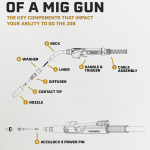
A MIG gun has nine core parts. Four of them sit at the front end and are consumables: the nozzle, contact tip, diffuser and liner. Three make up the body of the gun: the neck, the handle and trigger, and the cable assembly. Two more connect and protect it: the insulator and the power pin. The consumables wear out and get replaced. The rest get specified once, when the gun is configured.
MIG welding is a common welding process especially useful for beginner and DIY welders due to its easy-to-learn nature, shorter lead times and lower production costs. The versatility of MIG welding allows users to work on a wide range of materials with less stopping and restarting. The process features a continuous consumable wire electrode being fed through a welding gun and into a weld pool. The gun also feeds a shielding gas alongside the wire to protect the weld pool from contaminants.
While there are different types of MIG guns that have unique parts (e.g., water-cooled, air-cooled, fume extraction), all MIG guns have some parts in common. Understanding the components of a MIG gun and the process by which it works will help you make decisions on the consumables and gun type you select for your job. Here is every part, what it does, and what goes wrong when it fails.

MIG Gun Parts at a Glance
| Part | Type | What it does | What happens when it fails |
|---|---|---|---|
| 1. Nozzle | Consumable | Directs shielding gas over the weld puddle and shields internal gun components from heat and spatter | Spatter build-up blocks gas flow, causing porosity |
| 2. Contact tip | Consumable | Transfers welding current to the wire and guides it to the work surface | Inconsistent feeding, arc instability, burnback |
| 3. Diffuser | Consumable | Conducts electricity to the contact tip and disperses gas evenly across the pool | Uneven gas coverage, contamination, porosity and oxidation |
| 4. Liner | Consumable | Guides the wire from the feeder through the cable to the contact tip | Friction, erratic feeding, arc instability, poor weld quality |
| 5. Neck | Component | Positions the arc and shielding gas on the joint and houses the front-end parts | Poor joint access, restricted visibility, operator strain |
| 6. Handle and trigger | Component | Operator interface and arc control | Fatigue and reduced arc-on time |
| 7. Cable assembly | Component | Delivers power, gas, filler metal and control signals to the gun | Loss of any one of the four and the gun stops performing as intended |
| 8. Insulator | Component | Electrically isolates gun components and acts as a thermal barrier | Overheating and malfunction |
| 9. Power pin | Component | Connects the gun to the machine or feeder for wire, gas and weld power | Inefficient transfer of wire, gas and power |
The Four Front-End Consumables
These four sit closest to the arc, take the heat and the spatter, and are designed to be replaced. Nearly all of a MIG gun’s running cost and most of its downtime concentrate here.
Nozzle. The nozzle directs the shielding gas to cover the weld puddle. By shielding the weld puddle, the nozzle helps to prevent spatter on the weld surface while simultaneously protecting internal components of the gun from heat and spatter. Nozzle size and condition matter more than most operators expect. A nozzle that is too narrow for the application clogs with spatter and stops delivering enough gas, which is one of the most common causes of porosity. Shielding Gas for MIG Welding covers the gas side of the same problem.
Contact tip. The contact tip guides the wire and transfers the current from the neck through the filler metal and to the work surface. Consistent wire feeding ensures a stable arc and high weld quality. Tip life is where consumable spend concentrates, and how far the tip sits inside the nozzle changes penetration and spatter as much as the tip itself does. Correct Contact Tip Recess Can Improve Welding Efficiency covers how to set it.
Because trim-length errors and liner misalignment sit behind so many feeding problems, a consumable system that locks the liner concentrically in place, such as Bernard AccuLock™ S consumables, keeps a flawless wire-feed path and delivers up to 3x contact tip life compared with standard tapered contact tips.
Diffuser. The diffuser conducts electricity to the contact tip while dispersing gas evenly across the weld pool. Ensuring even distribution of shielding gas ensures consistent coverage of the weld pool, preventing contamination and defects like porosity and oxidation.
Liner. The liner guides the wire electrode from the wire feeder through the cable to the contact tip. A worn or low-quality liner can cause friction, leading to inconsistent feeding and arc instability and, ultimately, poor weld quality. There are several materials of liners for consideration, each with advantages in different applications. The liner is also the part most often replaced incorrectly, because a rear-load liner has to be measured and trimmed at the feeder end. Bernard MIG welding gun liners include a front-load system that is trimmed at the front of the gun instead, which removes the measuring step.
The Gun Body: Neck, Handle, Trigger and Cable
These MIG gun components are configuration choices rather than consumables. They get specified when the gun part number is built, and they are matched to the operator and the joint rather than swapped out during a shift.
Neck. The neck is the front-end extension of a MIG welding torch and houses vital components like the contact tip, gas nozzle and wire feeder inlet. It directs the welding arc and shielding gas precisely onto the weld joint, improving weld quality and consistency. Selecting the right neck, long versus short, is important because it impacts a welder’s posture, visibility and heat control. Neck length and angle are configurable on Bernard semi-automatic MIG guns, which is why the same gun platform can serve a fixture and an overhead field joint.
Handle and trigger. The handle and trigger impact how long an operator can weld without experiencing fatigue. Handles with an ergonomic design and a natural feeling grip will improve operator comfort and welding duration. When selecting a trigger, it needs to be responsive to the touch and best suited for the job, whether multi-schedule or locking. Ergonomics is not a comfort line item, it is arc-on time. MIG Welding Basics: Techniques and Tips for Success covers the posture and gun-angle side of the same problem.
Cable assembly. In MIG welding, the cable assembly delivers power, gas, filler metal and control signals to the welding gun. Without the successful transmission of each of these elements, the weld will not perform as intended. Compression fittings are an integral aspect of the assembly because they provide a reliable connection, better energy transfer and less resistance.
The Two Parts Nobody Thinks About Until They Fail
Insulator. The insulator plays a critical role in electrical isolation and heat management. Made of a non-conductive material, it helps electrically isolate the metal components of the welding gun, including the trigger mechanism, from the electrical circuit carrying the welding current. It also acts as a thermal barrier between the nozzle and the trigger mechanism, preventing overheating and malfunctions.
Power pin. Power pins provide a direct connection for wire, weld power and gas flow between the welding machine or wire feeder and the MIG gun. An accurate gun-to-machine connection is critical to ensure that the filler wire, gas and weld power are passed efficiently to the gun. Power pin style is machine-specific, which is why it is one of the fields in the gun configurator rather than a universal part. Power Pins lists the available options.
How to Find the Right MIG Gun Parts for Your Gun
Knowing what each part does is the first half of the problem. Matching a part to a specific gun already on the floor is the other half, and it is where most operations lose time.
Three tools handle it. If you have the gun and need replacement parts, reverse lookup takes an existing gun part number and returns the full replacement parts list with a downloadable exploded view diagram. If you are building or replacing a gun, the MIG gun configurator walks through handle, trigger, neck, cable, power pin, wire size and consumable family, then returns the part number to order. Both live under Configure My Gun. If the label on the gun is gone, Help Me Identify My Product narrows it down.
For a closer look at the front-end parts specifically, see Welding Gun Consumables: What You Need to Know. Confirm final part numbers and availability with an authorized Bernard and Tregaskiss distributor before ordering.
Frequently Asked Questions
Q: What are the parts of a MIG welding gun?
A: Nine: the nozzle, contact tip, diffuser, liner, neck, handle and trigger, cable assembly, insulator and power pin. The first four are front-end consumables that wear and get replaced. The rest are components specified when the gun is configured.
Q: Which MIG gun parts are consumables?
A: The nozzle, contact tip, diffuser and liner. They sit closest to the arc and take the heat and spatter, so they are designed to be replaced. How long they last depends on amperage, duty cycle, wire type and how well the shielding gas is protected at the front end.
Q: Are MIG gun liners universal?
A: No. Liner selection depends on the gun model, the cable length and the wire diameter, so a liner from one gun will not necessarily fit another. Check the gun’s replacement parts list, or run reverse lookup on the gun part number, before ordering.
Q: Are MIG guns interchangeable between welding machines?
A: Not automatically. The gun connects to the machine or wire feeder through the power pin, and power pin styles are machine-specific. A gun built for one feeder will not always connect to another without the correct power pin.
Q: What is the difference between a contact tip and a nozzle?
A: The contact tip carries the welding current to the wire and guides it into the joint. The nozzle surrounds the tip and directs shielding gas over the weld pool. One handles electricity and wire, the other handles gas.
Q: How do I know when to change a MIG gun liner?
A: Erratic wire feeding, birdnesting at the drive rolls and an unstable arc are the usual signs. Because a worn liner adds friction along the entire wire path, the symptoms often look like a wire feeder problem rather than a gun problem.
Q: How do I find the part number for a MIG gun part?
A: Use reverse lookup on bernardtregaskiss.com. Entering an existing gun part number returns the full replacement parts list and a downloadable exploded view diagram you can print, save or email.
Nine Parts, Four That Wear
A MIG gun is nine parts, and only four of them wear out. That distinction is important, because nearly all of the running cost and most of the unplanned downtime concentrate in these four that wear. Specify the neck, handle, trigger, cable and power pin once, matched to the operator and the joint, and they will not need revisiting. Then treat the front end as the running variable it actually is, and evaluate those MIG gun parts by what a failure costs rather than by what the part costs.